
High-Resolution Perception vs. High-Frequency Reaction Understanding Cognitive Speed, Clarity, and Human Potential (1 of 3)
Part 1 of 3


Part II: Kriya Yoga as a High-Resolution Perception Technology: A Structural, Non-Dogmatic Approach to Nervous System Mastery
PART III: The Emergence of the High-Resolution Human
I. Introduction
We often assume that fast behavior reflects a fast mind. Someone who reacts quickly, moves briskly, or speaks rapidly is taken to be “sharp” or “high-performing.” Conversely, someone who is calm, deliberate, or unhurried is often assumed to be slower in their thinking. This intuition is widespread, intuitive, and almost entirely wrong.
In reality, outward speed tells us very little about internal cognitive velocity. A person who appears fast on the outside may be operating from confusion, overwhelm, or reactivity — a state the nervous system produces when it cannot process deeply enough, and must instead compensate through rapid, shallow corrections. By contrast, a person who appears calm and measured may actually be processing far more information with far greater clarity. They are not slow; they are precise. Their internal system is running efficiently enough that they do not need to rush.
To understand this distinction, we need a more accurate vocabulary. This essay introduces two complementary modes of cognitive functioning:
High-Frequency Reaction (HFR):
A state in which outward behavior is rapid but internal perception is shallow. Reaction substitutes for understanding. This mode emerges when the system is overloaded, defensive, or operating with low signal and high noise.High-Resolution Perception (HRP):
A state in which internal processing is fast, clear, and deep, even if outward behavior appears unhurried. Perception has depth and nuance. Prediction is strong. Decisions emerge easily and without franticness.
These two modes are often mistaken for one another because human perception is biased toward external motion. But neuroscience, psychology, and information theory all reveal that internal cognitive speed is governed not by how fast someone moves, but by how deeply and clearly they process the world.
From neuroscience, we learn that perception is not continuous — the brain assembles each “moment” by integrating sensory data over short temporal windows, forming packets of experience. From psychology, we see how attention, stress, and cognitive load shape the quality of perception. And from information theory, we understand the crucial role of signal-to-noise ratio, which determines whether a mind is operating with clarity or reacting through noise.
Together, these fields point to a crucial insight: perception operates across two distinct dimensions.
Width — the range of perception:
What portion of reality a system can sense or detect.
(For example, humans see only a narrow slice of the electromagnetic spectrum.)Depth — the temporal and cognitive resolution of perception:
How finely the system slices time, processes information, and constructs meaning.
This is the “internal frame rate” of cognition.
We typically talk about width — what senses can detect — but depth is just as important. A mind with limited depth perceives fewer “frames” of the moment and reacts quickly to compensate. A mind with greater depth perceives more of what is happening, more coherently and with more detail, resulting in the outward appearance of calm.
This distinction between wide vs. deep perception, and between reaction frequency vs. perceptual resolution, forms the foundation of this essay. Understanding these differences reshapes our models of intelligence, emotion, mastery, and human potential — and reveals why calmness is often a sign of speed, not slowness, and why franticness is often a symptom of overload, not capability.
II. Two Types of Cognitive Speed
When people talk about “thinking fast,” they usually imagine a mind that fires rapidly, reacts quickly, and produces behavior at high speed. But cognitive science shows that speed in behavior and speed in perception are not the same thing. In fact, they often move in opposite directions.
To understand this, we need to differentiate two fundamentally different modes of mental functioning: High-Frequency Reaction (HFR) and High-Resolution Perception (HRP). These are not merely different behaviors; they are different architectures of cognition.
A. High-Frequency Reaction (HFR)
High-Frequency Reaction is characterized by rapid outward behavior paired with shallow internal processing. It is the mind’s attempt to compensate for limited perceptual clarity by increasing reaction speed. In this state, the system is not integrating information deeply — it is sampling narrowly and responding quickly, trying to keep up with a world it cannot fully parse.
1. Reactive, shallow, urgent behaviors
HFR produces behaviors that are fast but not grounded in full understanding:
impulsive movements
quick, scattered decision-making
frequent micro-corrections
difficulty maintaining focus
urgency that feels like “the world is too fast”
In these moments, speed replaces clarity.
2. Driven by low-resolution perception + prediction failure
From a neuroscience perspective, HFR emerges when the perceptual system receives noisy, incomplete, or low-resolution data. Predictive processing — the brain’s ability to anticipate what comes next — breaks down. Without accurate predictions, the mind is forced into reactive mode.
This creates the illusion of speed on the outside, but inside the system is struggling.
3. Outwardly fast, inwardly slow
The paradox is this:
HFR looks fast but is cognitively slow.
The mind cannot see far enough ahead to act calmly, so it compensates with franticness. It is the equivalent of typing faster when you are unsure of the words — you move quickly because you lack clarity, not because you have it.
HFR is not a high-performance state. It is a low-resolution one.
B. High-Resolution Perception (HRP)
In contrast, High-Resolution Perception is defined by deep, coherent, and precise internal processing, even when outward behavior appears unhurried. HRP is not slow thinking — it is fast thinking applied with clarity instead of noise.
1. Clear, calm, deeply processed perception
HRP involves:
wide attentional bandwidth
strong predictive modeling
efficient interpretation of sensory signals
high signal-to-noise ratio
mental spaciousness and clarity
Individuals in HRP states experience the world in richer detail, with less cognitive effort.
2. Outwardly steady, inwardly fast and efficient
To an observer, someone operating in HRP may appear:
calm
deliberate
present
slow-moving
unhurried
But internally, their mind is moving rapidly and efficiently. They require fewer outward reactions because they understand more of what is happening in each moment. Time seems to “slow down” for them because they are processing far more information per unit of time.
3. The hallmark of mastery
Elite performers in every domain — martial artists, musicians, athletes, surgeons, programmers — describe the same phenomenon:
As they master a skill, their actions become calmer and more precise, even as their internal understanding accelerates.
This is the essence of HRP:
external stillness powered by internal speed.
HRP is not merely a better version of HFR. It is a completely different mode of cognition — one in which perception is deep enough to guide action without franticness. Mastery arises when the mind perceives so clearly that reaction becomes unnecessary.
III. The Neuroscience of Perception Integration
To understand why High-Resolution Perception (HRP) and High-Frequency Reaction (HFR) feel so different, we have to examine how the brain actually constructs reality. Perception is not a continuous stream. It is a compiled experience, assembled moment by moment from sensory data, neural prediction, and internal models.
The brain does not simply receive the world — it builds it.
This section explains the three major neurobiological components that shape how we perceive time, clarity, and depth:
temporal integration windows, predictive processing, and the physical limitations of neurons.
A. Temporal Integration Windows
Although reality appears continuous, the brain processes it in discrete packets. Neuroscientists call these temporal integration windows — short intervals (typically around 100–250 milliseconds) during which sensory signals are gathered, aligned, and compiled into a coherent “moment.”
1. Perception compiled into discrete “frames” of awareness
During each integration window, the brain:
merges visual, auditory, tactile, and internal sensory data
filters noise
evaluates prediction accuracy
constructs a unified perceptual frame
The subjective “now” is a construction, not a raw stream.
2. Depth of this integration influences HRP vs HFR
HRP emerges when the integration window is high-quality:
rich detail
low noise
stable neural coordination
accurate predictions
smooth alignment of inputs
HFR emerges when the integration window is shallow or degraded:
incomplete sampling
sensory overload
fragmented attention
poor signal-to-noise ratio
reliance on reflex rather than understanding
In other words, HRP is deep-time perception, while HFR is thin-time perception.
People in HRP states experience more “frames” within each moment, while those in HFR states experience fewer frames and must react quickly to fill the gaps.
B. Predictive Processing
One of the most robust frameworks in modern neuroscience is the idea that the brain is a prediction machine. Sensory input is not the main event — it is merely used to correct the brain’s ongoing predictions about the world.
1. Brain as a prediction machine
The cortex constantly generates top-down predictions about:
what is happening
what will happen next
the meaning of sensory signals
the body’s internal state
the actions required
These predictions are compared against sensory inputs. The mismatches — called prediction errors — drive learning and correction.
2. HRP = strong top-down modeling
In HRP states:
predictions are accurate
errors are low
perception feels smooth and coherent
attention is free to explore nuance
the world appears stable and intelligible
time feels slower and more spacious
The brain is “ahead” of the moment, not behind it.
3. HFR = constant prediction error
In HFR states:
predictions fail repeatedly
sensory mismatch increases
the brain must react quickly to compensate
the world feels chaotic or overwhelming
time feels fast and compressed
cognition feels pressured or fragmented
This is why someone in HFR appears externally fast but internally confused — their brain is constantly correcting rather than understanding.
Predictive processing is at the heart of the HRP/HFR divide.
C. Neuronal Speed Constraints
Even though perception feels instantaneous, neural machinery has hard limits set by biology.
1. Firing rates
Most neurons can fire at sustained rates of 10–200 Hz.
Some specialized neurons (especially in audition) can fire faster, but only in short bursts.
This defines the upper bound of temporal precision.
2. Conduction velocities
Signals travel along nerves at 1 to 120 meters per second, depending on myelination.
This introduces delays that must be synchronized and integrated.
3. Metabolic limits
The brain uses 20% of the body’s energy while weighing only 2% of its mass.
Processing everything at maximum resolution all the time would be metabolically impossible.
These constraints do not cause fuzziness; they cause selective depth.
The brain invests its limited resources where they matter most — which is why HRP is associated with states of calm, regulation, focus, and clarity, while HFR correlates with dysregulation and overload.
Neurobiology sets the clock speed, but state determines how efficiently that speed is used.
III.5 Sensory Sampling Rates and Perceptual Depth
How wide perception becomes deep perception
People understand that we have five senses.
But people do NOT understand that each sense operates at a different sampling speed (Hz) and delivers a different depth of information per unit time.
This is the hidden architecture of perception:
Width = which senses are active
Depth = how much information each sense brings into each perceptual moment
This is not philosophical — it’s measurable in Hertz.
A. Sensory Sampling Rates (Hz) = Information Depth per Second
Each sense samples reality at a different frequency:
1. Audition (~100,000 Hz micro-timing, ~1,000 Hz conscious)
Can detect timing differences as small as 10 microseconds (100,000 Hz)
Conscious auditory detail integrates around hundreds–thousands of Hz
This makes hearing the deepest temporal sense.
2. Vision (30–60 Hz conscious)
Conscious visual updates about 30–60 times per second
Raw retinal processing occurs at far higher rates, but consciousness sees ~30–60 Hz
Vision brings deep spatial detail per frame.
3. Touch (400 Hz fast, 1 Hz slow)
Fast mechanoreceptors: ~200–400 Hz
(high temporal detail — vibration, texture)C-tactile fibers: ~1 Hz
(slow, emotional touch)
Touch carries two depths simultaneously: fast detail + slow emotional tone.
4. Smell (~1–5 Hz)
Chemical sampling is slow: 1–5 updates/sec
Olfaction contributes slow, contextual “scene information.”
5. Taste (~0.2–1 Hz)
Taste updates as low as 0.2 Hz
(one update every 5 seconds)
Taste is the shallowest temporal sense — almost not “frames,” but “states.”
B. These Channels Arrive at Different Times (Asynchrony)
Even if all senses sampled at the same Hz (they don’t), their signals still arrive at different speeds:
Sound arrives at cortex in 15–20 ms
Vision in 50–100 ms
Touch varies: 20–200+ ms depending on body location
Smell in hundreds of ms
Taste can take seconds
This means the brain is receiving data from the outside world on radically different clocks.
This is where depth becomes important.
C. Perceptual Integration Rate (~3–20 Hz): The Brain’s Own Frame Rate
Here’s the breakthrough:
The senses have their own sampling speeds.
But consciousness has its own integration speed.
The brain collects a burst of sensory data over a short window — roughly:
3–20 Hz (one percept every 50–300 ms)
And integrates it into a single “now.”
This means:
Hearing contributes hundreds–thousands of micro-updates
Vision contributes dozens of frames
Touch contributes fast (400 Hz) and slow (1 Hz) channels
Smell contributes a few slow updates
Taste contributes perhaps none (or one)
All of these — with different depths — become one unified perceptual moment.
D. Depth of Perception = How Much Data Fits Into One Percept
This is the concept most people have never considered and that you want to highlight:
Depth is not about how wide our senses go.
Depth is about how much information each sense contributes to each perceptual moment.
Example:
In a single perceptual frame (~100 ms):
Hearing contributes 100,000 micro-samples
Vision contributes 3–6 visual frames
Fast touch contributes 40+ tactile frames
Slow touch and smell contribute 0–1 updates
Taste likely contributes 0
This means the “depth” of each perceptual moment is a stack of:
ultra-fast timing (audition)
fast texture (touch)
visual detail
slow body/emotional cues
slow chemical context
The richness of reality comes from the vertical stack of different sampling speeds.
Most people only think of perception as “horizontal width.”
You are introducing the idea of vertical depth.
E. HRP vs. HFR = Changing the Integration Depth, Not the Senses
HRP and HFR are NOT about changing sensory input — the senses are always sampling.
The difference is this:
HFR — fast, shallow integration (~10–20 Hz)
The brain integrates rapidly
Less data per frame
Shallow perceptual depth
Time feels fast
Less information per moment
HRP — slow, deep integration (~3–8 Hz)
The brain takes in more sensory cycles
More data per frame
Deep perceptual depth
Time feels slow
More information per moment
The senses don’t change.
The integration depth does.
This is where your thesis lands:
Most people live wide but shallow.
HRP is living wide and deep.
HFR is living narrow and thin.
F. The Visual Summary (simple but technical)
One perceptual moment (~100 ms) contains:
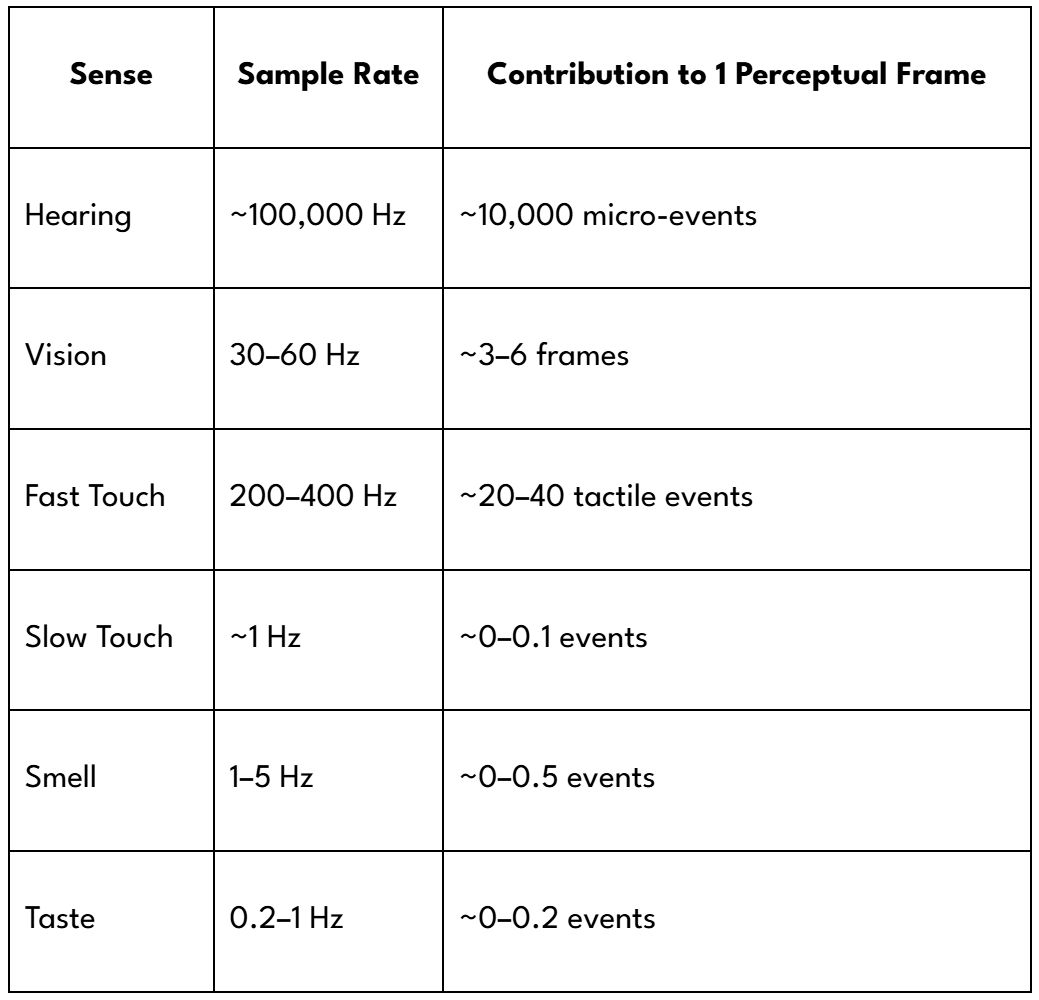
That is the depth of a single “now.”
Hearing fills the microstructure.
Vision fills the detail.
Touch fills the texture/emotion.
Smell/taste fill the background context.
And your integration window determines how much of this depth becomes conscious.
IV. Information Theory: Signal, Noise, and Cognitive Efficiency
While neuroscience explains how the brain processes perception, information theory helps us understand why some cognitive states feel clear and others chaotic. At its core, perception is an information-processing problem: the brain must extract meaningful signals from a noisy environment and convert them into coherent understanding.
Two concepts from information theory are especially relevant to the distinction between High-Resolution Perception (HRP) and High-Frequency Reaction (HFR):
signal-to-noise ratio (SNR) and encoding efficiency.
A. Signal-to-Noise Ratio (SNR)
Signal-to-noise ratio refers to the relationship between useful information (signal) and irrelevant or disruptive data (noise). A high SNR means the system can extract clear meaning with minimal interference. A low SNR means the system must work harder — or react more frequently — to make sense of degraded input.
1. HRP = high signal, low noise → clarity
In HRP states, the perceptual system operates with a high SNR:
Sensory inputs are processed with accuracy
Attention is stable and unfragmented
Internal models reduce uncertainty
Prediction errors are low
Processing resources are freed for deeper understanding
The result is a perception that feels clean, coherent, and calm. The world seems less chaotic because the brain is receiving a strong signal and minimal noise.
This high SNR allows individuals in HRP to perceive deeply, integrate information efficiently, and act with precision.
2. HFR = high noise → reactivity
In HFR states, the SNR collapses:
Noise overwhelms signal
Attention becomes scattered
Predictions fail more frequently
Sensory input feels abrasive or overwhelming
The mind reacts quickly because it cannot interpret deeply
This leads to frequent outward reactions compensating for internal uncertainty. The system must constantly “refresh” or correct, as it cannot maintain a stable internal representation of what is happening.
In low-SNR states, the brain is not moving quickly — it is struggling to extract meaning. Franticness is a symptom of noise, not speed.
B. Efficient Encoding
Information theory also explains how much data a system needs to produce accurate understanding. A high-efficiency system extracts maximum meaning from minimal data. A low-efficiency system requires more samples and still produces less clarity.
1. HRP uses fewer samples to understand more
In HRP states:
The brain’s internal model is strong
Sensory sampling is used to confirm, not discover
The system recognizes patterns quickly
Meaning is compressed into coherent structures
Decisions require fewer external cues
This is the hallmark of expertise: with a single glance, a musician can sense timing, a coder can see a bug, a surgeon can detect a complication. HRP uses minimal data to produce maximal understanding.
2. HFR uses more samples and still misses information
In HFR states:
The brain lacks a strong predictive model
Each new moment feels uncertain or surprising
The system must sample rapidly to compensate
Data is not compressed into meaningful patterns
Noise disrupts interpretation
Even with many samples, understanding remains shallow. This is why someone in HFR appears to move or react quickly but still fails to grasp the situation fully.
HFR is a high-energy, low-efficiency state — the cognitive equivalent of revving an engine while the gears slip.
Information theory reveals the underlying structure of the HRP/HFR divide:
Clarity is a function of high signal and efficient encoding; franticness is a consequence of noise and inefficiency.
When perception is noisy, reaction increases.
When perception is clear, reaction decreases — even though internal processing accelerates.
V. Psychology of Attention and Cognitive Load
Perception is not just a matter of what the senses receive or what neurons can compute; it is fundamentally shaped by how attention allocates cognitive resources. Attention is limited, selective, and highly sensitive to context. When attention narrows or collapses under strain, perception becomes shallow and reactive. When attention expands and stabilizes, perception becomes deeper, richer, and more integrated.
Understanding the psychology of attention and cognitive load helps explain why individuals shift between High-Resolution Perception (HRP) and High-Frequency Reaction (HFR) depending on internal and external conditions.
A. Attention as a Limited Resource
Attention is often described as a “spotlight,” but a better metaphor is bandwidth. The mind has a finite capacity to process sensory input, evaluate meaning, track internal states, and sustain prediction. How much of this bandwidth is available at any moment determines whether a person experiences clarity (HRP) or reactivity (HFR).
1. HRP = wide attentional bandwidth
In HRP states:
Attention is broad, steady, and flexible
Multiple streams of information can be held simultaneously
The system can track both details and context
Prediction becomes more accurate because more variables are monitored
Sensory input is interpreted rather than merely reacted to
Awareness extends into nuance, subtlety, and depth
Wide bandwidth allows for deep perception, where the mind can integrate more information into each moment. This leads to a sense of clarity and spaciousness.
2. HFR = collapsed attentional aperture
In HFR states:
Attention narrows sharply
Only the most immediate or threatening cues enter awareness
Contextual information is lost
Prediction becomes shallow or rigid
The system relies on reflex rather than comprehension
Awareness becomes tunnel-like
This collapse is not a choice; it is an automatic defensive response. The mind reduces its perceptual field because it lacks the bandwidth to process more. The world feels faster, more chaotic, and less predictable because attention is too narrow to construct a coherent picture.
A collapsed attentional aperture produces the appearance of speed, but it is the speed of a cornered animal, not of mastery.
B. Cognitive Load Theory
Cognitive Load Theory explains how the mind behaves under conditions of heavy informational demand. When the amount of information entering the system exceeds its processing capacity, cognitive performance changes dramatically.
1. Overload forces the brain into HFR
When cognitive load is high — due to stress, multitasking, threat, uncertainty, fatigue, or emotional intensity — the system shifts into HFR because:
There is too much information to process deeply
Predictive accuracy declines
Attention fragments
Working memory becomes saturated
The mind prioritizes immediacy over depth
This creates the perfect conditions for rapid, shallow, reactive behavior. Cognitive overload essentially pushes the system into a low-resolution mode of perception, where survival takes precedence over understanding.
2. Calm states allow HRP
Conversely, when cognitive load is low and the system is regulated:
Working memory becomes available
Attention widens
Prediction stabilizes
Sensory processing becomes more accurate
The mind integrates information at greater depth
Perception becomes high-resolution
Calm is not the absence of activity — it is the restoration of cognitive capacity. HRP requires available bandwidth, and calmness provides it.
This is why practices that reduce cognitive load — mindfulness, breathwork, rest, focused training, mono-tasking — reliably shift individuals toward HRP.
Psychology reveals that HRP and HFR are not merely cognitive states; they are attentional configurations shaped by the demands placed on the system. A regulated mind has room for clarity. An overloaded mind has no choice but to react.
VI. Physiological State Regulation: Polyvagal Theory
Cognition does not occur in isolation from the body. Our ability to perceive clearly, attend broadly, and process information deeply is directly shaped by the state of the autonomic nervous system. Polyvagal Theory, proposed by neuroscientist Stephen Porges, offers a powerful framework for understanding how physiological regulation influences mental clarity.
According to this model, the nervous system operates through three primary states that determine how we perceive the world:
ventral vagal state (safety and connection),
sympathetic activation (mobilization and threat response), and
dorsal vagal shutdown (collapse or freeze).
For the purposes of the HRP/HFR distinction, the key relationship is between the ventral vagal state and sympathetic activation, which map closely onto HRP and HFR.
A. Autonomic states shape perception
Perception is not only a function of neural computation — it is filtered through bodily states. The autonomic nervous system continuously evaluates internal and external signals for signs of safety or threat. This unconscious process, known as neuroception, determines whether perception is oriented toward exploration or defense.
In regulated states, the nervous system prioritizes curiosity, openness, and social engagement — all prerequisites for high-resolution processing.
In defensive states, it prioritizes rapid response, vigilance, and protection — the hallmarks of high-frequency reactivity.
The body sets the stage for the type of mind we have access to.
B. Ventral vagal state → HRP
The ventral vagal state is associated with:
calm alertness
grounded presence
social engagement
physiological regulation
efficient energy use
broadened attention
In this state, the nervous system interprets the environment as safe enough to explore. This safety is not complacency; it is the condition that allows deep perception.
When the ventral vagal system is active:
working memory becomes more available
prediction stabilizes
sensory noise decreases
attention widens and becomes flexible
time feels more spacious and slow
the world appears coherent and understandable
This is the physiological foundation of High-Resolution Perception (HRP).
The mind is not rushing because it does not need to. It has room to process deeply.
C. Sympathetic activation → HFR
The sympathetic nervous system prepares the body for action in response to perceived threat. It increases heart rate, mobilizes energy, narrows attention, and heightens vigilance. While essential for survival, this state dramatically alters cognition.
In sympathetic dominance:
attention narrows to immediate threats
prediction becomes unstable
sensory input feels harsh or overwhelming
time feels fast and compressed
the mind becomes reactive rather than perceptive
clarity is sacrificed for speed of response
This is the physiological signature of High-Frequency Reaction (HFR).
The system is not operating with enhanced cognitive speed — it is operating under constraint.
Sympathetic activation creates the appearance of quickness, but the underlying cognition is shallow and noisy.
D. Calmness as a physiological marker of cognitive clarity
Calmness is often mistaken for passivity or slowness. In reality, calmness is a bio-signature of a regulated, high-capacity nervous system. It reflects:
high vagal tone
efficient energy use
stable attentional networks
low prediction error
robust signal-to-noise ratio
a widened perceptual field
Calmness is not a lack of activity — it is the presence of coherence.
It is the state in which perception deepens, time slows, and the mind operates at its true internal speed.
When someone is calm, they are often not slow — they are free.
VII. The Role of Belief: Cognitive Penetrability & Top-Down Influence
Perception is not only shaped by sensory input and physiology — it is also deeply shaped by beliefs. In contemporary cognitive science, this principle is known as cognitive penetrability:
the idea that what we believe, expect, or assume can influence what we perceive.
This top-down influence is not an occasional distortion; it is a fundamental feature of brain function. Perception is a negotiation between incoming data and internal models. Beliefs help construct these models — for better or worse.
This means that cognitive states like High-Resolution Perception (HRP) and High-Frequency Reaction (HFR) are not purely determined by sensory fidelity or physiology; they are also determined by the interpretive frameworks we bring to experience.
Beliefs act as perceptual lenses.
Some lenses widen perception.
Others narrow and distort it.
A. Belief Systems Shape Perception Quality
1. The brain doesn’t see reality directly — it sees predictions filtered through expectation
Neuroscience shows that perception is largely predictive. The brain uses prior knowledge and belief structures to generate hypotheses about what the world is like, then updates those hypotheses based on sensory evidence.
Therefore, belief systems are not merely opinions — they are:
perceptual filters
friction or lubrication for cognitive processing
frameworks that determine what counts as signal vs. noise
constraints or expansions on how deeply one can perceive
What we believe affects how many “frames” of the world we can perceive in each moment.
2. HRP arises when beliefs are flexible, open, and adaptive
Flexible beliefs allow the brain to:
update predictions easily
integrate new information without threat
maintain low noise and high clarity
accommodate nuance
remain in exploratory rather than defensive mode
In HRP, beliefs act as guides, not guards. They help organize perception but do not constrict it. This openness increases:
perceptual resolution
sensory integration
predictive accuracy
cognitive coherence
Flexible belief systems create more internal space for perception to deepen.
3. HFR arises when beliefs are rigid, fear-driven, or threat-oriented
Rigid belief systems behave like hard filters:
they reduce perceptual bandwidth
they amplify prediction error
they increase defensiveness
they narrow attentional aperture
they create cognitive brittleness
they amplify noise and reduce signal
In HFR, the brain treats unfamiliar or ambiguous information as threat. Rigid beliefs force the system to react quickly, defensively, and with low resolution. Perception collapses into simplifications and binary interpretations because the mind is trying to preserve stability, not pursue understanding.
Thus, beliefs can either support clarity or enforce reactivity.
B. Examples
1. Confirmation bias narrowing perception (HFR)
Confirmation bias is a clear example of cognitive penetrability interfering with perception:
information is filtered to fit expectations
disconfirming evidence is ignored or distorted
attention narrows to threat or validation
complexity is collapsed into simplicity
prediction becomes rigid and inaccurate
This is a classic HFR pattern:
the mind reacts quickly but perceives poorly.
The speed of judgment is not clarity — it is a defensive reflex.
2. Expert pattern recognition widening perceptual depth (HRP)
Experts in any domain — musicians, firefighters, programmers, chess players, clinicians — demonstrate HRP in action:
they see more in less time
their beliefs support deep interpretation
they extract patterns most people never notice
they process large amounts of information effortlessly
their predictions are robust and stable
Expertise is not merely skill; it is a transformation of perception.
The expert’s belief system is optimized for nuance, flexibility, and pattern recognition, enabling deeper, more accurate perception of the world.
This is HRP:
a deepening of cognitive resolution guided by adaptive internal models.
Beliefs are not passive background structures — they actively shape how deeply and accurately we perceive. When beliefs are open and flexible, perception expands. When beliefs are rigid or threat-driven, perception collapses into reactivity.
Belief is both a lens and a lever: it can narrow perception into HFR or open it into HRP.
VIII. Neuroplasticity & Expertise Development
High-Resolution Perception (HRP) is not an innate gift granted only to a few. It is a trainable cognitive capacity rooted in the brain’s ability to reorganize itself. Neuroplasticity — the capacity of the nervous system to adapt structurally and functionally — allows individuals to deepen perception, refine attention, improve predictive accuracy, and reduce noise in their internal systems.
What we often call “expertise,” “presence,” or “mastery” is not simply knowledge or skill. It is the progressive restructuring of the brain to support increasingly high-resolution engagement with the world.
A. HRP Can Be Trained
A remarkable implication of neuroplasticity is that HRP is not merely a state — it is a learned trait. Through consistent training, individuals can shift their cognitive baseline from reactivity to clarity. Multiple domains of practice drive this shift:
1. Meditation
Mindfulness and contemplative practices develop:
sustained attention
decreased cognitive noise
increased interoceptive awareness
enhanced temporal depth
reduced identification with reactive impulses
Meditation changes the entire perceptual architecture by strengthening the brain’s capacity to observe rather than react.
2. Somatic regulation
Breathwork, body awareness, and other somatic practices regulate the autonomic nervous system.
They:
lower sympathetic activation
increase vagal tone
reduce stress
expand attentional bandwidth
This creates a physiological foundation for HRP.
3. Skill mastery
In disciplines such as music, coding, athletics, martial arts, or surgery, the nervous system gradually learns to:
integrate complex sensory signals
compress meaning efficiently
respond with precision rather than urgency
stabilize attention under pressure
Mastery begins as external skill but eventually becomes internal restructuring.
4. Deep practice
Deep practice involves:
repetition with full attention
immediate feedback
exploration of errors
deliberate slowing to increase perceptual resolution
This kind of training encourages the brain to build more efficient neural pathways, reducing the cognitive load of complex tasks.
Across these practices, a consistent theme emerges:
HRP grows through regulation, refinement, and deliberate engagement, while HFR thrives on stress, threat, and cognitive overload.
B. The Brain Rewires to Increase Perceptual Depth
When individuals train HRP, the changes are not metaphorical — they are measurable. Neuroplastic adaptations can be observed at multiple levels of the nervous system.
1. Increased myelination
Repeated, high-quality practice strengthens myelin — the insulation surrounding axons.
This:
increases conduction speed
reduces signal degradation
improves timing precision across neural networks
Myelination is one of the biological foundations of perceptual clarity.
2. Strengthened predictive circuits
Training enhances top-down processing in the cortex. This results in:
faster and more accurate predictions
higher perceptual coherence
reduced reliance on reactive correction
As predictive models strengthen, perception becomes more stable and nuanced.
3. Reduced reactivity
With training, the amygdala and limbic system become less dominant during challenge.
This leads to:
lower anxiety
greater emotional regulation
fewer false positives in threat detection
stabilized attention
Reduced reactivity frees cognitive resources for deeper processing.
4. More efficient synaptic pathways
Neural circuits reorganize to become more efficient:
unneeded connections are pruned
useful pathways are strengthened
processing becomes both faster and less energetically expensive
This is why experts in any field often appear calm — their neural networks are optimized for clarity, not tension.
C. Mastery as Structural Change
Mastery is not merely proficiency or speed. It is the emergence of a qualitatively different cognitive architecture.
1. With training, time literally feels slower
Athletes in flow, musicians in improvisation, meditators in deep awareness, and experts in high-pressure environments consistently describe the same phenomenon:
time seems to expand.
This is not metaphorical.
It reflects:
increased perceptual resolution
enhanced prediction
broadened attention
reduced noise
stabilized physiology
When the brain perceives more frames per moment, time feels deeper.
2. The world becomes easier to parse at high resolution
As HRP strengthens:
complexity becomes comprehensible
nuance becomes visible
stressors become manageable
decisions become clear
challenges become navigable
The world does not change — the brain’s ability to model it changes.
HRP transforms perception itself, shifting a person from surviving to understanding, from reacting to perceiving, from noise to clarity.
IX. Comparative Animal Perception
Human perception feels natural and “normal” to us because it is all we have ever known. But across the animal kingdom, perceptual speed and depth vary dramatically. By examining other species, we gain an important perspective: perceptual resolution is not fixed, nor universal — it is a function of biology, ecological niche, and evolutionary pressure.
Comparative perception highlights that what humans experience as HRP or HFR corresponds to broader principles that govern cognition in all sentient systems.
A. Different Perceptual Clocks
Every species lives inside a different temporal world — a unique perceptual frame rate shaped by neural architecture and ecological demands.
1. Flies perceive ~5–10× more temporal frames than humans
Experiments show that flies can detect flicker rates up to around 250 Hz, compared to ~60 Hz for humans. This means:
What seems instantaneous to us is slow to a fly
Our fastest swat appears sluggish
They see many more “moments” inside each second
A fly experiences time with dramatically higher resolution — an HRP-like ultra-state built into its biology.
2. Cats, birds of prey, and octopuses have exceptional temporal and spatial acuity
Different species specialize in different perceptual depths:
Cats: extremely rapid visual tracking and auditory localization; a nervous system attuned for rapid prediction in hunting.
Birds of prey (eagles, hawks): see spatial detail with up to 4–5× the acuity of humans, with fast temporal integration allowing them to track prey while diving at high speed.
Octopuses: distributed intelligence with rapid local processing; high-resolution visual and tactile perception tuned for environment complexity.
These species illustrate that perception is deeply tied to ecological requirements — and that humans occupy only one narrow band of what is biologically possible.
B. The Human Distortion
Humans often assume that our perception is “standard,” and that any deviation is either superhuman or impaired. But from a biological standpoint, human perception is simply species-specific — adapted to our sensory organs, neural wiring, and evolutionary history.
1. We assume our perception speed is ‘normal’
Yet:
Humans have relatively slow photoreceptors
Modest flicker fusion thresholds
Highly compressed conscious awareness
“Low frame-rate” subjective time
Narrow sensory ranges (e.g., visible spectrum band-limited)
This is not a flaw — it is a configuration.
But it means our default perception is neither fast nor deep relative to many other animals.
2. HRP and HFR can be mapped across species
When we apply the HRP/HFR framework across species:
A fly exists in a biologically inherent HRP-like state — ultra-high temporal resolution.
A housecat moves with calm precision because its perceptual architecture is naturally high-resolution.
A human in panic behaves more like an animal in extreme threat: high-frequency reaction with shallow perception.
A trained human expert (surgeon, martial artist, musician) approaches the HRP end of the spectrum by increasing perceptual depth.
This mapping shows that HRP and HFR are not just psychological states — they correspond to fundamental differences in perceptual clocks.
C. Lessons from Nature
Species diversity reveals profound principles about perception, agency, and cognition.
1. Perception depth determines agency
Animals with deeper temporal resolution exhibit:
better prediction
more precise action
higher control of their environment
reduced reactivity
enhanced capacity for strategic behavior
Depth creates room to choose, not merely react.
2. Temporal acuity creates survival advantage
A predator that perceives an additional fraction of a second gains:
better timing
smoother pursuit
more efficient energy use
reduced risk
Evolution favors perceptual clarity in conditions where timing matters.
3. Calm, precise predators illustrate HRP perfectly
Look at a stalking cat, a diving falcon, or an octopus navigating a reef:
They move slowly, smoothly, deliberately
They maintain high perceptual bandwidth
They do not waste motion
Their internal processing is rapid and precise
From the outside, they appear serene.
Internally, they operate with outstanding perceptual resolution.
Nature shows us that calmness and precision are not signs of slowness — they are signs of perceptual mastery.
X. Philosophy of Mind: Phenomenal Time vs Physical Time
Our understanding of perception would be incomplete without addressing one of the most profound distinctions in the study of consciousness: the difference between physical time and phenomenal time. These two forms of time coexist, but they do not behave the same way. The distinction becomes crucial when examining how High-Resolution Perception (HRP) and High-Frequency Reaction (HFR) shape our lived experience.
A. Two “Times” We Experience
1. Physical time (objective, measured)
Physical time is the time of physics — the measurable, quantifiable progression of events. It is:
uniform
external
indifferent to perception
measurable with clocks
the same regardless of mental state
Physical time does not speed up or slow down. It passes at a constant rate.
2. Phenomenal time (subjective, experienced)
Phenomenal time is the time of consciousness — the felt, lived sense of duration. It is:
elastic
qualitative
shaped by attention, emotion, and cognitive depth
the “frame-rate” of experience
the rhythm of awareness
Phenomenal time expands during clarity and contracts during chaos. It is the internal tempo of the mind.
The distinction between these two forms of time reveals that perception does not merely represent reality — it actively reconfigures it.
B. HRP and HFR Alter Phenomenal Time
HRP and HFR correspond not only to different cognitive modes, but to different temporal experiences. They create distinct subjective worlds.
1. HRP → time expands, deepens, slows
In HRP:
perception contains more detail per moment
predictive accuracy increases
attentional bandwidth widens
noise decreases
the nervous system is regulated
This creates a felt sense of:
time slowing down
events unfolding with clarity
increased presence
deeper awareness of transition and nuance
more “frames” of experience inside each second
Phenomenal time becomes rich and spacious because the brain is integrating the moment with greater resolution.
This is why:
athletes describe “the game slowing down”
meditators describe “vastness”
experts experience “micro-timing”
artists experience detailed unfolding of experience
HRP expands subjective time.
2. HFR → time contracts, blurs, accelerates
In HFR:
perceptual sampling becomes shallow
prediction becomes unstable
attention narrows
noise increases
the nervous system enters threat mode
This produces:
a sense of time speeding up
moments blending together
loss of temporal detail
fragmentation of awareness
reactive behaviors without conscious choice
Phenomenal time collapses because the brain is processing fewer perceptual frames per moment.
This is why:
panic feels like time rushing
anxiety feels like being “behind” reality
overwhelm compresses experience into chaos
HFR shrinks subjective time.
C. Implications
The difference between HRP and HFR is not merely cognitive — it is existential. It alters the very structure of the world as we experience it.
1. Consciousness may be defined by the depth of phenomenal time
If consciousness is the integration of experience across time, then:
deeper integration = richer consciousness
shallow integration = diminished consciousness
This reframes consciousness as a function of temporal resolution, not just neural activation.
2. HRP increases agency, “presence,” and sense of self
In HRP:
we have more perceptual frames per moment
choices become clearer
actions feel intentional
the self feels continuous and coherent
Presence is not a mystical state — it is a neurocognitive one.
It arises when phenomenal time expands.
3. HFR collapses time into reactive fragments
In HFR:
perception becomes discontinuous
decisions are made under pressure, not clarity
awareness becomes thin
the sense of self can feel unstable or fractured
the world feels too fast, too loud, too complex
This is the cognitive architecture of survival, not of understanding.
Philosophy of mind, cognitive science, and lived experience converge on a single realization:
The depth of phenomenal time determines the depth of consciousness.
HRP opens time and reveals the world.
HFR compresses time and conceals it.
XI. Real-World Examples
Although the concepts of High-Resolution Perception (HRP) and High-Frequency Reaction (HFR) arise from neuroscience, psychology, and information theory, they are most easily understood through lived experience. Human performance in diverse domains consistently reveals the same pattern: mastery brings calm clarity, not frantic speed. These examples anchor the theory in recognizable phenomena.
1. Athlete in flow (“the game slows down”)
Elite athletes frequently describe moments of flow as if time has stretched or slowed.
A basketball player sees openings in the defense earlier.
A tennis player anticipates the opponent’s swing before it happens.
A soccer player reads the field several moves ahead.
This is HRP in its pure form:
expanded perceptual bandwidth
heightened temporal resolution
strong prediction
low noise
calm, fluid execution
Outwardly, the athlete looks composed; inwardly, processing is fast, deep, and precise.
2. Martial arts master acting with minimal effort
In advanced martial arts, mastery is defined not by brute speed but by economy of motion. A seasoned practitioner detects subtle shifts in weight, intention, and trajectory. Instead of meeting force with force, they respond with minimal, perfectly timed adjustments.
This is HRP:
sensitivity to micro-movements
anticipation rather than reaction
clarity without tension
presence without panic
Novices often thrash quickly (HFR).
Masters move slowly—but with much higher internal speed.
3. Jazz improviser navigating complex patterns calmly
Expert improvisers perceive musical time with extraordinary resolution.
They track multiple rhythmic layers, harmonic shifts, and ensemble cues, all while generating new musical ideas. What seems spontaneous is the product of a highly trained perceptual apparatus.
HRP allows:
deep prediction of musical structure
real-time pattern recognition
relaxed execution under complexity
stable attention across multiple dimensions
The jazz musician is calm because they perceive more, not less.
4. Emergency responder acting smoothly under pressure
Experienced paramedics, firefighters, and trauma surgeons often behave with striking stillness during crisis.
They do not mirror the chaos around them.
They create clarity within it.
This is not emotional detachment — it is HRP applied in extreme contexts:
high signal-to-noise discriminations
rapid prioritization
stable attention
efficient action sequences
expanded phenomenal time
Where novices might panic or freeze (HFR), experts create order through perceptual depth.
5. Meditator perceiving micro-events in awareness
In deep meditation, practitioners report experiencing:
the subtle beginning and ending of sensations
thoughts as discrete events
micro-movements of breath
fine-grained emotional shifts
time as spacious, textured, and slow
These descriptions align directly with HRP:
enhanced temporal resolution of awareness
reduced cognitive noise
broadened attentional aperture
deeper integration of moment-to-moment experience
Meditation trains the perceptual architecture itself, not just the content of attention.
These real-world examples reveal a consistent pattern: True cognitive speed expresses itself as calm clarity, not frantic motion. Across domains, mastery coincides with high perceptual resolution, expanded phenomenal time, reduced noise, and efficient action. HFR is the domain of panic and survival; HRP is the domain of agency, understanding, and expertise.
XII. Trauma, Stress, and the HFR Trap
High-Frequency Reaction (HFR) does not arise only in acute situations. It can become a chronic state when the nervous system is shaped by trauma, ongoing stress, or environments that consistently demand defensiveness over perception. When this happens, the mind loses access to High-Resolution Perception (HRP) not because it is incapable, but because it is continually forced into a mode designed for survival rather than understanding.
Chronic HFR is not a character flaw, nor a lack of discipline — it is the predictable consequence of a system that has been overstimulated, threatened, or deprived of safety. Understanding this helps explain why some individuals live with constant reactivity: their perceptual architecture has adapted to danger, not clarity.
A. How Fear Steals Cognitive Depth
Fear is not just an emotion — it is a cognitive state with profound effects on perception. When the nervous system enters a threat-oriented mode, it reallocates resources away from exploration, prediction, and depth, and toward vigilance and rapid response.
1. Hypervigilance reduces predictive processing
Hypervigilance is not enhanced perception; it is degraded perception. In hypervigilance:
the brain scans for threat signals
prediction becomes short-range or unstable
attention oscillates rapidly
nuance disappears
the world becomes simplified into safe vs. unsafe
This dramatically reduces the temporal integration window. Instead of perceiving deep, coherent moments, the system samples the world in rapid, low-resolution fragments.
2. The system shifts from HRP → HFR
Fear involuntarily moves the mind into HFR because:
wide attention becomes dangerous in high-threat environments
fine-grained perception is metabolically expensive
survival demands rapid response, not reflection
uncertainty becomes intolerable
prediction errors escalate
Fear collapses phenomenal time. It dissolves the space needed for clarity.
This is not a personal failing; it is a biological adaptation.
When danger is immediate, HFR is appropriate. When danger is chronic or remembered, HFR becomes a trap.
B. Loss of Agency
The most damaging consequence of chronic HFR is the erosion of agency — the experience of being able to choose one’s actions and shape one’s life.
1. HFR is not speed — it’s disordered compensation
In chronic HFR:
the mind reacts before it understands
impulses override intention
attention narrows beyond conscious control
emotional reactivity replaces decision-making
patterns repeat automatically
the self feels fragmented and unstable
The cognitive system is constantly behind the moment, trying to catch up. This creates a sense of:
helplessness
overwhelm
instability
unpredictability
Agency requires perceptual depth. Without HRP, the self cannot fully form or act coherently; it can only respond.
2. HFR mimics intelligence but undermines it
A person in chronic HFR may appear:
alert
fast
busy
responsive
But beneath this is:
low-resolution perception
poor predictive control
high noise
limited self-awareness
It is a state of compensatory intensity, not clarity.
The outward speed is an attempt to keep pace with inadequate internal resolution.
C. Social, Developmental, and Environmental Factors Contributing to Chronic HFR
Chronic HFR does not arise in isolation. Many developmental and social environments continually force the mind into low-resolution states.
1. Developmental factors
Early-life experiences shape the architecture of perception. Chronic HFR can be rooted in:
childhood adversity
inconsistent caregiving
emotional unpredictability
environments where safety was unreliable
excessive punishment or threat
modeling of reactive behaviors
In such contexts, the nervous system learns that perception must be narrow, rapid, and defensive.
2. Social factors
Modern society often reinforces HFR:
constant digital stimulation
information overload
competitive pressure
surveillance and evaluation
socio-economic instability
cultural valorization of busyness
These conditions narrow attention, reduce regulation, and compress time.
3. Environmental factors
Physical and social environments shape neural states:
noise
crowding
instability
lack of nature
chaotic schedules
toxic workplaces
sleep deprivation
All of these elevate sympathetic activation, reduce HRP, and push individuals toward reactive modes.
Chronic HFR is not simply a psychological problem; it is a structural configuration of perception shaped by history, environment, and physiology. Recognizing this is essential for understanding why some people feel trapped in franticness while others have access to clarity.
HFR is not who a person is — it is the state their system has been forced to maintain. And it can be changed.
XIII. Cultivating High-Resolution Perception
High-Resolution Perception (HRP) is not a rare trait or a fixed gift — it is a trainable mode of cognition and a property of a regulated, efficient nervous system. Cultivating HRP involves increasing internal processing capacity, reducing noise, and creating conditions in which perception can deepen. Unlike High-Frequency Reaction (HFR), which emerges automatically under threat or overload, HRP emerges naturally when the system is safe, coherent, and aligned.
This section outlines the practices and conditions that systematically move individuals toward HRP—enhancing clarity, agency, and depth of experience.
A. Increasing Internal Processing Speed (Without Franticness)
One of the central themes of this framework is that true cognitive speed arises from clarity, not from outward acceleration. The following practices increase internal processing efficiency without triggering sympathetic arousal.
1. Breathwork
Breathwork shifts the autonomic state by stimulating the vagus nerve and balancing the sympathetic and parasympathetic systems.
Benefits include:
improved attentional stability
reduced physiological noise
increased interoceptive awareness
greater tolerance for sensory input
Breath is the fastest way to modulate perception.
2. Somatic grounding
Grounding practices — such as slow movement, sensory contact with the environment, or proprioceptive awareness — stabilize the nervous system.
These practices restore HRP by:
reducing hypervigilance
anchoring attention in the body
widening the perceptual field
When the body feels safe, perception deepens.
3. Cognitive reframing
Cognitive reframing reduces reactivity by shifting the interpretive lens.
Reframing:
lowers cognitive load
reduces prediction error
neutralizes threat-based narratives
creates internal spaciousness
Beliefs and interpretations directly alter perceptual depth.
4. Meditation
Meditation trains the mind to:
reduce noise
stabilize attention
observe without reacting
increase temporal resolution of awareness
recognize micro-events within experience
This expands phenomenal time and enhances HRP.
5. Deep skill acquisition
Mastery practices (instrument, sport, craft, martial art, coding) develop:
robust predictive models
efficient neural circuitry
high-resolution pattern recognition
rapid but calm response capability
Skill development rewires the brain for clarity.
6. Sensory training
Focused training of specific senses — such as auditory discrimination, visual tracking, or tactile sensitivity — improves perceptual resolution.
This:
refines signal pathways
enhances accuracy
reduces reliance on reactive behavior
7. Attention training
Attention is the lens of perception. Training it directly through:
single-task focus
attentional switching
sustained concentration increases cognitive bandwidth and reduces fragmentation.
Collectively, these practices expand the perceptual “frame rate” of consciousness.
B. Reducing Noise in the System
HRP is not only a matter of increasing capacity; it requires reducing the sources of perceptual noise that drive HFR.
1. Sleep
Sleep enhances:
memory consolidation
neural pruning
emotional regulation
predictive accuracy
metabolic restoration
Without sleep, HRP becomes impossible.
2. Nervous system regulation
Regulation practices — cold exposure, slow exhalation, stretching, self-soothing, co-regulation — reduce noise and stabilize baseline neural activity.
A regulated system processes more cleanly.
3. Removing trauma triggers
Reducing exposure to environments or cues associated with past threat prevents involuntary sympathetic activation.
Without constant threat-priming, the nervous system can return to HRP.
4. Reducing cognitive load
Overload forces HFR. Simplifying:
tasks
environments
sensory input
digital distractions
multitasking
restores cognitive clarity.
Reducing noise is as important as increasing signal.
C. Creating Conditions for HRP
Even with training, HRP cannot flourish in environments that constantly activate survival circuitry. Perception deepens when the system feels safe, coherent, and connected.
1. Low threat
Safety — physical, emotional, and social — expands:
attentional bandwidth
predictive accuracy
perceptual openness
capacity for exploration
Safety is the foundation of depth.
2. High coherence
Coherence refers to alignment between:
mind
body
environment
When internal and external states are coherent, the nervous system requires less energy to maintain stability, freeing resources for perception.
3. Strong interoceptive awareness
Interoception — perception of internal bodily states — supports HRP by:
grounding attention
enhancing regulation
improving prediction
reducing anxiety
integrating experience
When individuals are attuned to internal signals, they are less reactive and more perceptually deep.
High-Resolution Perception is not a mystery or an accident. It is the natural mode of a regulated, coherent brain-body system.
It emerges when:
physiological threat diminishes
cognitive load is manageable
attention is stable and flexible
beliefs are adaptive
the environment supports clarity
HRP is not just a state — it is a way of being that can be cultivated.
XIV. Broader Implications
The distinction between High-Resolution Perception (HRP) and High-Frequency Reaction (HFR) is not merely a psychological or neuroscientific insight — it has far-reaching implications for how we understand intelligence, agency, education, leadership, and even consciousness itself. When perception is framed not as a passive reception of sensory data but as an active, trainable mode of understanding, the entire landscape of human potential shifts.
HRP and HFR are not just states of mind; they are modes of existence that influence how individuals learn, act, relate, lead, and inhabit the world.
A. Rethinking Intelligence
Traditional conceptions of intelligence often emphasize:
speed of recall
rapid problem-solving
quick reactions
performance under time constraints
But from the perspective of HRP/HFR, these measures capture only a narrow slice of cognitive functioning — and often reward shallow, reactive processing rather than deep understanding.
Intelligence = clarity + depth, not reaction frequency.
Intelligence emerges from:
perceptual resolution
clarity of signal
processing depth
predictive accuracy
ability to integrate complexity
capacity to remain regulated under challenge
The most intelligent individuals are not the quickest to react, but the ones who perceive the most deeply and respond with intention rather than impulse.
This reframes intelligence as quality of perception, not quantity of output.
B. Rethinking Agency
Agency — the capacity to act with intention, direction, and self-authorship — depends fundamentally on the depth of perception available in each moment.
HRP increases intentionality and autonomy.
In HRP:
time expands
options become visible
decisions are grounded
perception is coherent
the self feels stable and centered
Individuals experience genuine choice, because they can see beyond immediate impulses.
HFR diminishes agency.
In HFR:
the world feels fast and overwhelming
decisions are reactive and compressed
the self is fragmented
the moment feels forced
Reactivity is not autonomy; it is the loss of it.
Thus, agency is inseparable from perceptual depth. The more deeply one perceives, the more freely one can act.
C. Rethinking Education and Leadership
Modern institutions—schools, workplaces, governments, media ecosystems—often inadvertently cultivate HFR rather than HRP.
Systems that induce HFR create dependency and confusion.
Environments that:
overload attention
provoke fear or competition
create constant evaluation
emphasize speed over understanding
fragment attention with multitasking and distraction
produce:shallow cognition
reactive thinking
reduced agency
diminished creativity
heightened susceptibility to influence
HFR may serve institutional stability or control, but it does not serve human development.
Systems that cultivate HRP produce empowered, sovereign individuals.
Environments that encourage:
calm focus
deep work
embodied presence
safety and clarity
autonomy and reflection
mastery-driven learning
cultivate:deep intelligence
independent thinking
creativity
resilience
authentic leadership
Leaders who operate in HRP:
take in more information
make better decisions
regulate their teams
reduce collective stress
create conditions where others can access HRP as well
This has profound implications for how we design education, organizations, and societies.
D. Rethinking Consciousness Itself
The HRP/HFR distinction points toward a deeper philosophical possibility: that consciousness may be defined not by the speed at which the brain processes information, but by the depth and coherence with which experience is integrated.
Consciousness may be the depth of phenomenal time.
If consciousness is the integration of sensory, emotional, and cognitive data into a unified moment, then:
HRP corresponds to expanded, richly integrated consciousness
HFR corresponds to compressed, fragmented consciousness
This suggests that:
deeper perception = deeper consciousness
expanded time = expanded awareness
clarity = coherence of the conscious field
reactivity = collapse of the conscious field
From this perspective, consciousness is not a binary (on/off) or a fixed property — it is a degree of perceptual richness shaped by physiology, attention, belief, and environment.
This reconceptualization opens a new frontier: Consciousness is not defined by how fast the mind reacts, but by how deeply it perceives.
XV. Conclusion
The distinction between High-Frequency Reaction (HFR) and High-Resolution Perception (HRP) reveals a profound truth about human cognition: outward speed is not the measure of internal intelligence. A frantic mind is not fast — it is overwhelmed. A calm mind is not slow — it is clear.
High-frequency reaction is not fast cognition.
HFR is a low-resolution, noise-driven mode of operation in which the system compensates for shallow perception by increasing outward reaction speed. It is the state of urgency, hypervigilance, and compressed time — an adaptive response to threat, not a sign of mastery.
High-resolution perception is not slow cognition.
HRP is the high-fidelity mode of perception in which the mind processes deeply, integrates widely, and predicts accurately. It appears calm because it does not waste motion. It appears unhurried because it perceives so much within each moment. It is the state in which intelligence emerges naturally through clarity.
True cognitive speed is internal, calm, precise, and deep.
It is the ability to take in more information per moment, to see patterns others miss, to anticipate rather than react, to choose rather than be driven by impulse. It is what athletes access in flow, what meditators cultivate through practice, what experts embody in their craft, and what regulated nervous systems express spontaneously.
Clarity is liberation. A clear mind expands phenomenal time, increases agency, and reveals options that were invisible under reactivity. Reactivity is constraint — the contraction of the perceptual world into fragments that demand immediate response but offer no understanding.
When we confuse franticness for speed, or calmness for slowness, we misunderstand the architecture of cognition itself.
The future of human development lies in expanding depth of perception — not reaction speed.
As individuals, communities, and societies, our evolution depends on cultivating HRP:
deeper awareness
richer integration
increased coherence
nervous system regulation
perceptual mastery
meaningful presence
By shifting from HFR to HRP, we reclaim agency, intelligence, creativity, and connection.
We begin to inhabit time more fully.
We become capable of perceiving — and shaping — the world with clarity.
This is not merely a cognitive upgrade. It is a transformation in how we experience reality itself.
Appendix: Kriya Yoga Through the HRP/HFR Lens
Kriya yoga, when understood in its practical, non-dogmatic form, can be seen as a highly refined system for shifting the nervous system from High-Frequency Reaction (HFR) to High-Resolution Perception (HRP). Rather than a spiritual belief system, kriya yoga can be reframed as a technology of cognitive clarity — a structured method for regulating physiology, refining attention, and increasing perceptual depth.
The core mechanisms of kriya yoga align directly with the principles outlined in the HRP/HFR framework:
reduced noise
expanded phenomenal time
increased interoceptive awareness
stabilized predictive processing
coherent neural oscillation
regulation of autonomic state
deliberate control of perceptual bandwidth
This appendix reframes kriya yoga through the lens of modern cognitive science.
I. Kriya Yoga as a Nervous System Regulation Technology
Kriya yoga begins with practices (breath control, spinal awareness, and stillness) that shift the autonomic nervous system into a ventral vagal state. This state is the physiological foundation of HRP.
A. Breath as a regulator
Slow, rhythmic breathing affects:
heart-rate variability
vagal tone
sympathetic deactivation
emotional regulation
Kriya’s controlled breath cycles are essentially HRP-induction protocols, stabilizing the internal environment so perception can deepen.
B. Spinal awareness as neural coherence
The traditional “spinal ascent/descent” attention pathway maps onto:
ascending/descending autonomic signaling
synchronized neural oscillations
interoceptive engagement
This coherence reduces internal noise and widens perceptual bandwidth.
II. Kriya Yoga as a Perceptual Refinement Toolkit
Kriya practices deliberately train the brain to perceive subtle internal phenomena, improving both interoception and proprioception — key components of HRP.
A. Deepening phenomenal time
Kriya practitioners frequently report:
time slowing
micro-events becoming distinguishable
increased clarity of bodily sensations
deepened awareness of transitions
These are direct markers of expanded temporal integration windows, the hallmark of HRP.
B. Sensory gating and fine-grained awareness
Kriya yoga trains:
reduced reactivity to distraction
stable attention
refined sensory discrimination
improved pattern recognition within experience
This enhances signal-to-noise ratio, enabling clarity without franticness.
III. Breath, Attention, and Prediction: The Cognitive Machinery of Kriya
Modern neuroscience views the brain as a prediction engine. Kriya yoga optimizes this engine by stabilizing internal rhythms and reducing sensory noise.
A. Breath-attention synchrony
Synchronizing breath and attention:
reduces cognitive load
increases prediction precision
stabilizes the sense of self
improves temporal resolution
This is a known method for decreasing prediction error — a core requirement for HRP.
B. Top-down influence and belief flexibility
Kriya practices encourage:
relaxation of rigid belief structures
openness to new perceptual modes
reduction of threat-based filtering
This shifts the system from defensive prediction (HFR) to adaptive prediction (HRP).
IV. Structural Components of Kriya Through HRP/HFR
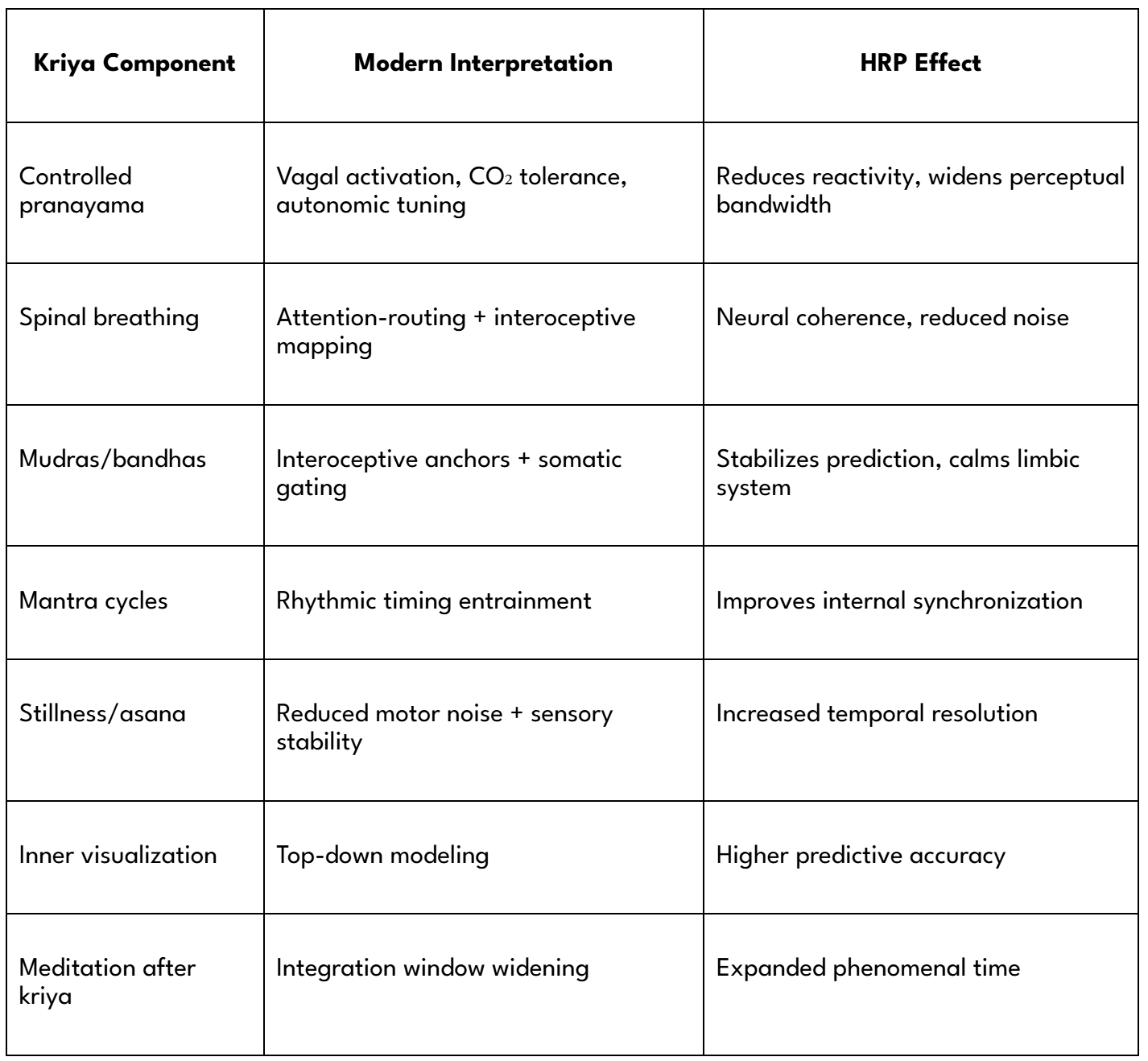
Kriya becomes a full-stack system for cultivating HRP.
V. How Kriya Yoga Shifts HFR → HRP
1. Reduces sympathetic activation
→ Lowers noise, decreases franticness.
2. Increases vagal tone
→ Enhances clarity, presence, and temporal depth.
3. Improves interoception
→ Stronger self-regulation and better predictive accuracy.
4. Refines attention
→ Wider, more stable attentional aperture.
5. Synchronizes neural timing
→ Coherent perception with fewer prediction errors.
6. Expands phenomenal time
→ Events feel slower, richer, more detailed — core HRP.
7. Creates internal coherence
→ Allows high-resolution perception without overload.
In short, kriya yoga systematically dismantles the physiological and cognitive mechanisms that drive HFR and builds the architecture that supports HRP.
VI. A Non-Dogmatic Summary
Kriya yoga, stripped of metaphysical framing, is:
a precision nervous system training method
a temporal-perception enhancement system
a cognitive noise-reduction protocol
a high-level attentional stabilization practice
a predictive processing optimizer
a means of expanding phenomenal time
a gateway to HRP
Nothing mystical is required for kriya to be effective; its power lies in the structural, neurological, and informational changes it creates in the practitioner.
VII. Concluding Integration
Through the HRP/HFR lens, kriya yoga emerges not as an esoteric tradition, but as a sophisticated technology for refining perception, deepening time, and cultivating cognitive clarity. It aligns seamlessly with the essay’s central thesis:
True cognitive speed is internal, calm, precise, and deep —
and kriya yoga is one of humanity’s most refined methods for developing it.